
Human hair extensions have become one of the most important products in the global beauty industry, especially in the United States and Europe. From luxury salons to online hair brands, the demand for high-quality Remy human hair extensions continues to grow every year.
But many distributors, salon owners, and private label brands still ask an important question:
👉 How are human hair extensions actually made?
Understanding the production process helps B2B buyers evaluate product quality, choose reliable suppliers, and build stronger hair extension businesses.
In this guide, we explain the complete manufacturing process of human hair extensions — from raw hair collection to final packaging.
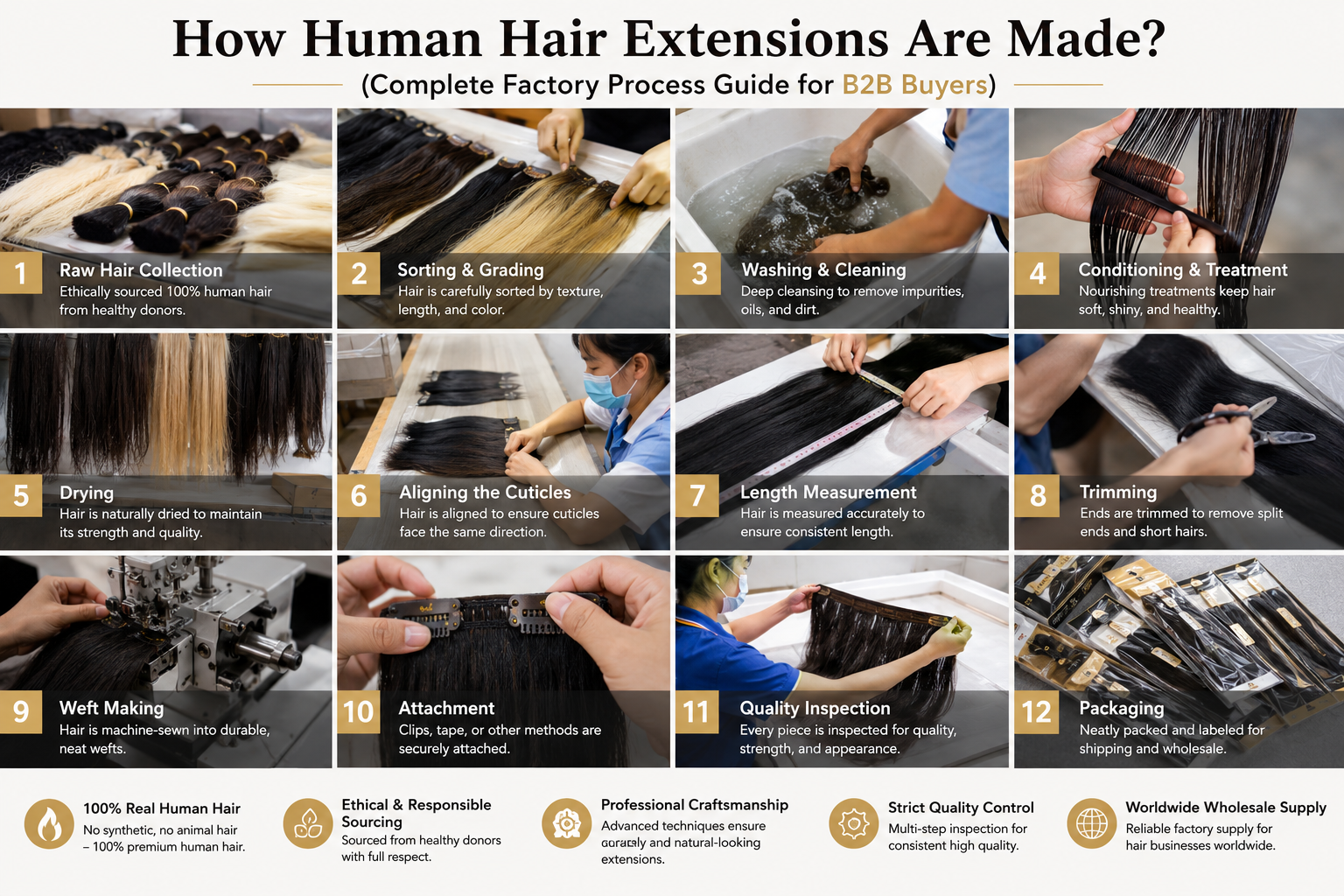
Step 1: Raw Human Hair Collection
The production process starts with sourcing raw human hair.
High-quality factories typically collect hair from:
- Hair donors
- Hair markets
- Hair collection networks
The most valuable raw material is:
👉 100% Remy menneskehår
Remy hair means:
- All cuticles remain aligned in the same direction
- Hair maintains a natural smooth structure
- Tangling is significantly reduced
This is the preferred standard for USA and European premium markets.
Step 2: Hair Sorting & Selection
After collection, the raw hair must be carefully sorted.
Factories separate hair based on:
- Længde
- Farve
- Texture
- Thickness
- Quality level
Professional manufacturers remove:
- Short hairs
- Damaged strands
- Mixed-direction hair
👉 Proper sorting is critical for consistent product quality.
Step 3: Cleaning & Sanitization
The hair then goes through a cleaning and disinfection process.
This stage removes:
- Dust
- Oil
- Residue
- Impurities
Professional factories use gentle cleaning methods to preserve:
- Hair softness
- Cuticle integrity
- Natural shine
👉 Over-processing can damage the hair structure and shorten product lifespan.
Step 4: Color Processing & Texture Treatment
Depending on customer requirements, factories may process the hair into different colors and textures.
Popular Hair Colors
Common shades include:
- Natural Black (#1B)
- Dark Brown (#2)
- Medium Brown (#4)
- Blond (#60 / #613)
- Balayage & Ombre colors
Popular Hair Textures for European & USA Markets
Professional hair extension factories can produce a wide range of textures to meet salon and market demand.
The most popular textures in European and USA markets include:
- Straight Hair
- Silky Straight Hair
- Body Wave Hair
- Loose Wave Hair
- Natural Wave Hair
- Soft Curly Hair
These textures are especially popular among salon clients seeking:
- Natural blending
- Lightweight movement
- Luxury salon appearance
- Easy daily styling
👉 High-quality Remy human hair extensions maintain softness, shine, and elasticity even after coloring and texture processing.
Step 5: Hair Weighing & Alignment
Before manufacturing extensions, the hair is:
- Measured precisely
- Weighed into bundles
- Aligned uniformly
Consistency is important because salons and distributors expect:
- Accurate bundle weight
- Full thickness from top to end
- Uniform quality across orders
👉 Stable production standards improve customer satisfaction.
Step 6: Manufacturing Different Hair Extension Types
The next stage depends on the final product category.
Tape-In Hair Extensions Production
For tape-in extensions:
- Hair is aligned carefully
- A thin polyurethane tape section is attached
- Medical-grade adhesive tape is applied
- Extensions are pressed and sealed securely
High-quality tape-ins should be:
- Lightweight
- Invisible after installation
- Reusable
- Comfortable to wear
Keratin Bond Hair Extensions Production
For keratin bond extensions:
- Hair is separated into strands
- Keratin adhesive is melted onto the tip
- Bond shapes are formed (U-tip, flat-tip, nail-tip, etc.)
- Tips are cooled and strengthened
Premium factories often use:
👉 Italian keratin for stronger and cleaner bonds
Weft Hair Extensions Production
Weft extensions are made by sewing hair together.
Common types include:
Machine Weft
Produced using industrial sewing machines.
Hand-Tied Weft
Crafted manually for thinner and more natural seams.
Genialt skud
Combines flexibility with strong construction.
👉 Weft construction quality directly affects durability and shedding.
Clip-In Hair Extensions Production
For clip-in extensions:
- Hair wefts are created
- Secure clips are sewn onto the wefts
- Weight and balance are checked
- Final quality inspection is completed
High-quality clip-ins should have:
- Strong clips
- Behagelig at have på
- Thick volume
- Minimal afskalning
Step 7: Quality Control Inspection
Professional factories perform strict quality control before shipment.
Inspection includes:
- Hair softness testing
- Shedding inspection
- Tangle resistance
- Color consistency
- Bond strength
- Weft durability
👉 Quality control is one of the biggest differences between professional factories and low-end suppliers.
Step 8: Packaging & Private Label Customization
After inspection, products are packaged for shipment.
Modern factories often provide:
- Emballage til private mærker
- Tryk af logo
- Luxury boxes & satin bags
- Custom branding solutions
OEM & private label services are especially important for:
- Salon chains
- Online stores
- Beauty brands
- Distributors
Step 9: International Shipping & Export
Professional manufacturers prepare:
- Dokumentation for eksport
- Sikker indpakning
- International shipping arrangements
Experienced factories regularly ship to:
- United States
- United Kingdom
- Germany
- France
- Italy
- Spain
- Other European markets
👉 Export experience helps ensure smooth and reliable delivery.
Why Manufacturing Quality Matters
The production process directly affects:
- Produktets levetid
- Customer satisfaction
- Salon performance
- Brand reputation
Poor manufacturing often results in:
- Sammenfiltring
- Fældning
- Dry texture
- Weak bonds
- Inconsistent orders
👉 Reliable production is essential for long-term business success.
How to Identify a Professional Hair Extension Factory
A reliable manufacturer should offer:
- 100% Remy menneskehår
- Stable production quality
- Full product range
- OEM & private label services
- Hurtig kommunikation
- Streng kvalitetskontrol
👉 Choosing the right factory is one of the most important decisions for B2B buyers.
Konklusion
Human hair extensions go through a detailed manufacturing process that combines raw material selection, technical craftsmanship, and strict quality control.
From tape-ins and keratin bonds to wefts and clip-ins, every production step affects the final product quality.
For distributors, salons, and hair brands targeting the USA and European markets, understanding how hair extensions are made helps ensure:
- Better supplier selection
- Higher-quality products
- Stronger customer satisfaction
- Long-term business growth
Looking for a Reliable Human Hair Extensions Factory?
If you are a distributor, salon chain, online store, or brand looking for:
- Premium Remy human hair extensions
- Stabil bulkproduktion
- OEM & private label services
- Konkurrencedygtige fabrikspriser
👉 We are ready to support your business growth.